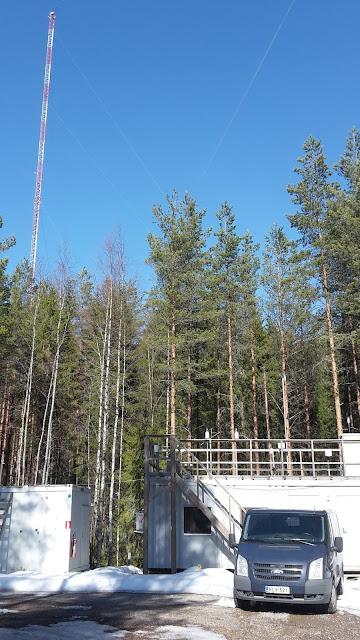
Posts

Showing posts with the label atmospheric chemistry

Tree emissions of volatile compounds are complex and not fully understood
Image
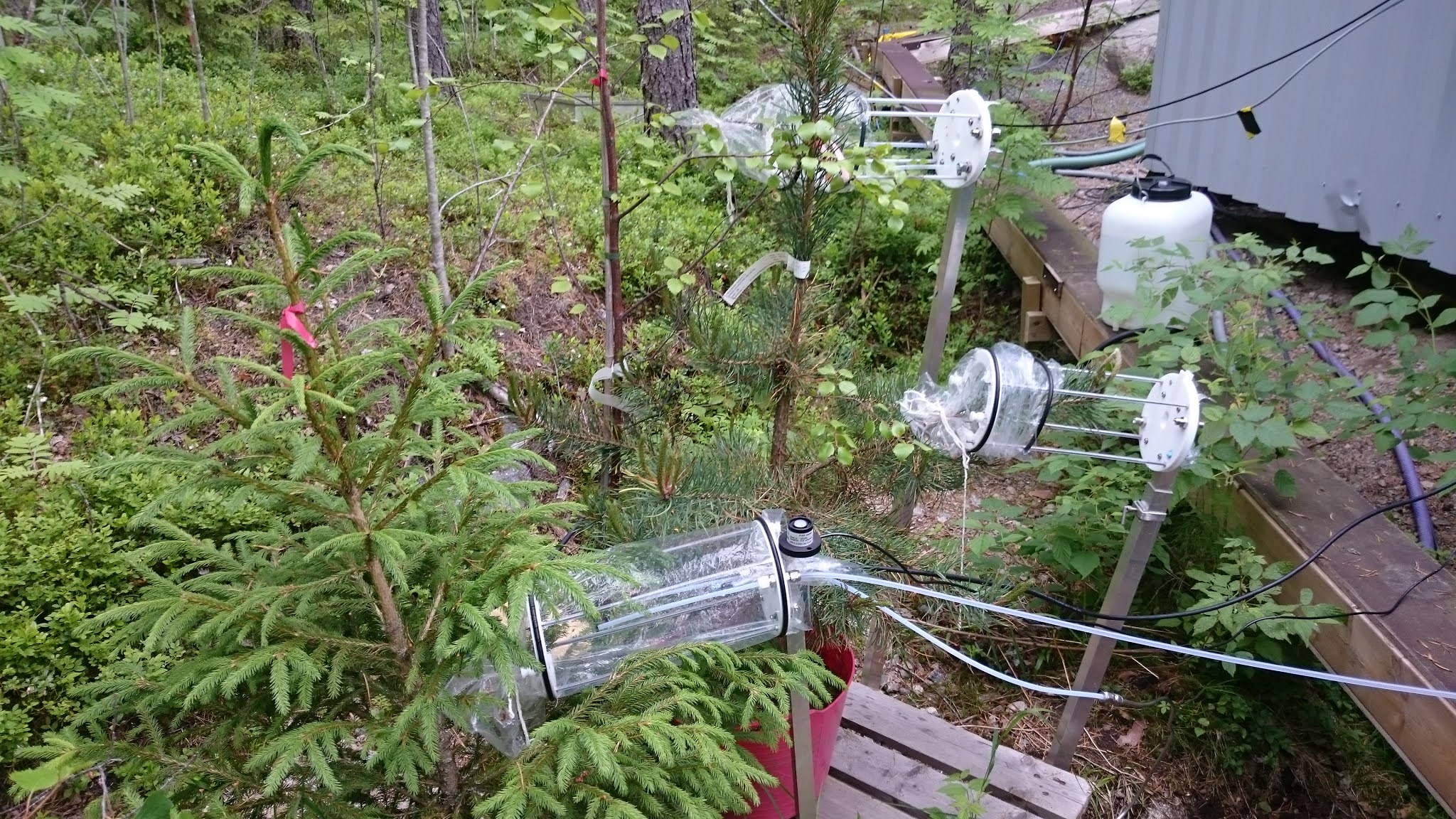
In our latest publication, we investigated with total hydroxyl radical (OH) reactivity measurements our understanding of emissions from three tree species found in the boreal forest. The unexplained fraction of the reactivity remain high in some circumstances. We recently published in Biogeosciences the results of our study from 2017, where we analysed the emissions from three different trees with gas chromatographic methods and total OH reactivity instrumentation. We analysed emissions at the branch level with enclosure for birch, spruce, and pine. Our findings are that emissions do vary in amount and composition throughout the growing season and we could show, based on reactivity measurements, that the emissions are not fully characterized chemically. In particular when trees were subject to stress (that was clearly visible with, for instance, browning leaves or needles) the reactivity of the emissions increased a lot and we observed simultaneously an increase of emissions of Green L...

Of good luck and bad luck...

Image
For many, 2020 will be remembered as quite a unique year, as many around the world are affected by the coronavirus pandemic and stay home for work, schools are closed, and everyone adapt to the unusual situation. In particular, for scientists, 2020 will be the year of the cancellations of not only international conferences, but also measurement campaigns. Last year, I was trying to organise a measurement campaign in Switzerland in 2020 for my projec t, but for various reasons, this was not possible. As an alternative, we decided to bring reactivity instruments (for both OH and ozone reactivity, the very first time this combination has been ever used to our knowledge) to Pallas in the Finnish Lapland in late March. As Anssi and I were preparing for the trip, COVID-19 slowly took on the news' cycle and Switzerland got hit quite badly by the pandemic. Did we just dodged a bullet? I guess we took a lucky decision without knowing. Still the first cases of COVID-19 were reported als...

Seasonality and knowledge gaps: Total hydroxyl radical (OH) reactivity measurements in the boreal forest

Image
After a long journey to get them published, the results of our hydroxyl radical (OH) reactivity measurements in the boreal forest in 2016 are now available in Atmospheric Chemistry and Physics . The final manuscript has been substantially modified from its discussion version, mostly to improve its readability and remove unnecessary parts. The most consequential changes did not severely impact our conclusions, though. Here I give a summary of the findings from our study that includes measurements at the SMEAR II boreal forest station in Hyytiälä, Finland, from April to July 2016, as well as modelling results from our colleagues at the University of Helsinki. We found large total OH reactivity values occurred when the soil was thawing after snow melted (late April). These reactivity peaks were even higher than the high total OH reactivity values in summer (July). Comparing the total OH reactivity measured with the OH reactivity calculated from the known chemical composition at ...

Another spring, another start of a measurement campaign

Image
It is a yearly routine: the temperature slowly increase and there is more light. It is then time to transport our instrumentation to the field! After our measurement campaign in Lapland last year (I wrote about it previously here and here ), this year we are back at the SMEAR II station in Hyytiälä in southern Finland. The SMEAR II station has become a hotspot for atmospheric sciences starting from the mid-1990s. The Finnish Meteorological Institute performs routine measurements there and research is also conducted at the site on Biogenic Volatile Organic Compounds (BVOCs) and other topics related to air quality. We performed an OH reactivity study at this site in 2016 (which is currently under review for Atmospheric Chemistry and Physics, see the open discussion ), which was building on previous studies by Sinha et al. (2010) and Nölscher et al. (2012) . Then, we extended the study period to include the spring and not only summer as the mentioned earlier studies. One result of ...

Campaign journal extracts: Lompolojänkkä, July 2018

Image
Following the installation of our instrumentation at Lompolojänkkä in the Finnish Lapland, the intensive measurement campaign was set for July. I spent two weeks there with my colleague and friend Dr. Simon Schallhart and decided to share with my readers some extracts of my campaign journal. Figure 1. From top to bottom: posing in front of the FMI car; unloading the car from the train in Rovaniemi; the measurement site at Lompolojänkä; wetland chamber; reindeer out of the apartment's window; hiking on Pallastunturit; stormy clouds over Lompolojänkä; oil leak; the FMI car being towed away; birthday champagne at the sauna; evening view over Pallasjärvi lake; branch enclosure for emissions measurements. (Photo credits: Arnaud Praplan and Simon Schallhart, CC-BY-4.0 ) 1 July 2018: The departure. 03:12PM. Today is warm and sunny. I came to FMI around 1PM to meet Simon and load the car. It took less time than expected and everything fitted! Yay! There was time to go to the sh...

Gordon Research Conference: Let's talk about biogenic hydrocarbons surrounded by forest!

Image
From 10 to 15 June I visited with a few of my colleagues the Gordon Research Conference 2018 on Biogenic Hydrocarbons and the Atmosphere . The conference was held in Les Diablerets, close to my native city in the Swiss Alps. Gordon Research Conferences are known to be at the cutting-edge of research with their policy of presenting latest results and strict rules about not disclosing anything that has been discussed at the conference to non-participants. It encourages discussing cutting edge research in an informal setting with lots of horizontal learning. Young and established researchers mix very well during meals, poster sessions, and free time activities. This was my second Gordon Research Conference after the one on Atmospheric Chemistry last year in Maine, U.S.A. It was a great opportunity to catch up with colleagues from various institutions, in particular with other researchers using the Comparative Reactivity Method (CRM) for total OH reactivity measurements. We could disc...

Boulder, CO. The international capital of atmospheric research?

Image
International collaboration is a cornerstone of modern science. This is why funding agencies generally make mobility an important part of any funding application. Academy of Finland is not different and my Academy Research Fellow project includes several instances of mobility. As I was preparing my proposal including ozone reactivity measurements, I was made aware of the unpublished work from Prof. Detlev Helmig and his team on this topic at the  Atmospheric Research Laboratory (ARL) , part of the  Institute for Arctic and Alpine Research (INSTAAR) at the University of Colorado in Boulder. After contacting Prof. Helmig, he agreed to host a laboratory visit in order for me to get familiar with their method. As the project got funded, the visit was settled for the beginning of 2018. Therefore, after visiting Prof. Matsumoto in Tokyo , I embarked on another trip, this time to the United States of America, and this time together with Anssi . I stayed for three weeks the...

Welcoming Anssi Liikanen

Image
Today we are pleased to welcome M.Sc. Anssi Liikanen as a new member of the Air Quality group at the Finnish Meteorological Institute. Anssi starts his PhD studies during which he will develop ozone reactivity measurements and conduct field measurements. As a part of my  REAC-FORTE  project (Academy of Finland, grant 307797 ), ozone reactivity will be used as a tool to assess our understanding of tree emissions and air chemistry in forest air at high latitude (Finland) and high altitude (Switzerland). Biogenic volatile organic compounds emitted by vegetation, such as isoprene and monoterpenes, have a double carbon-carbon bond in their structures, enabling reaction with ozone. By comparing the total ozone reactivity with the reactivity expected from known emissions in combination with other measurement techniques, we will be able to know how much of the chemical composition of forest air is still not well understood. Anssi's background in atmospheric sciences with a focu...

Teaching in the Arctic... in socks!

Image
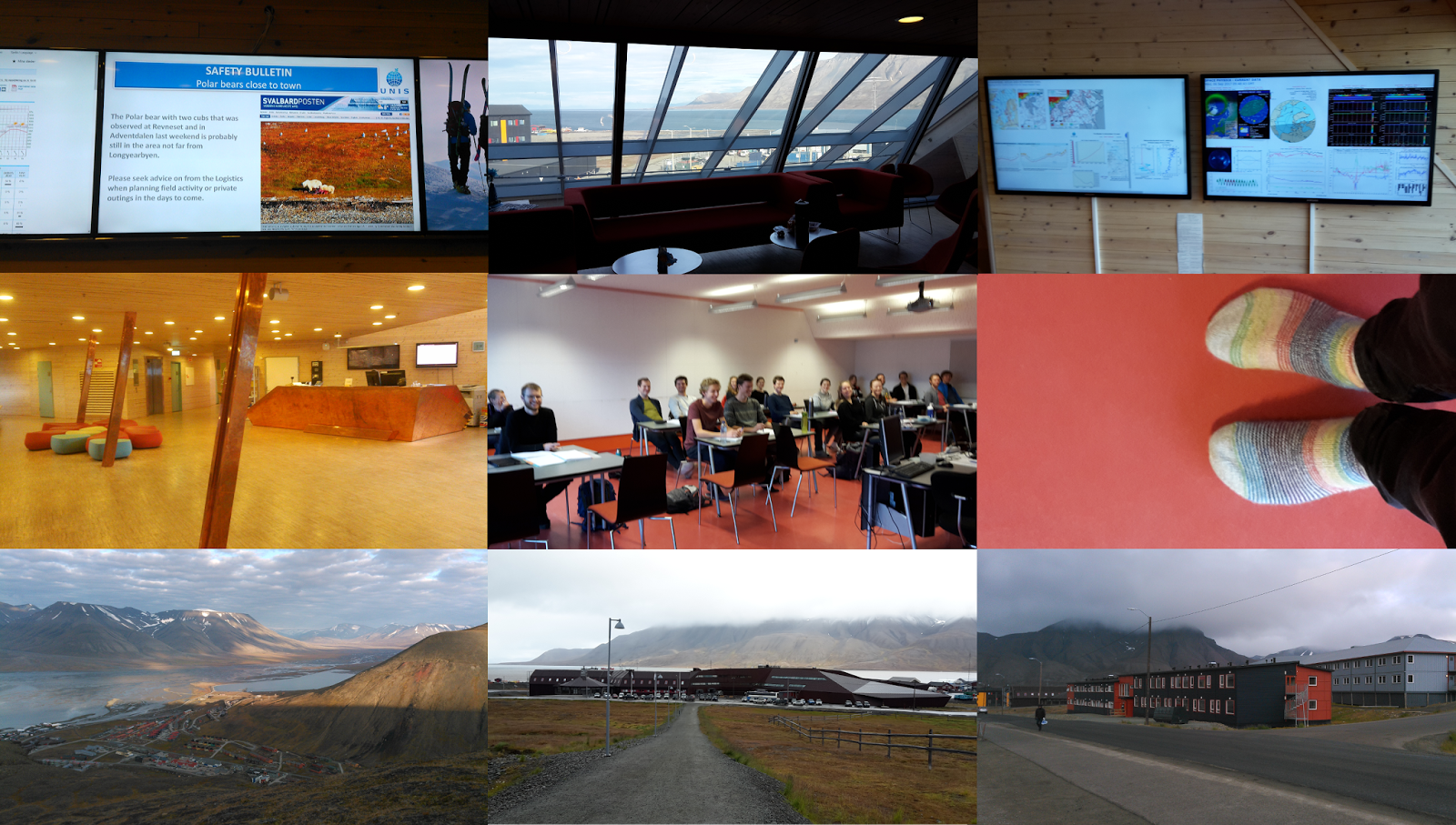
I was invited as a guest lecturer at the University Centre in Svalbard (UNIS) in Longyearbyen between 4 and 8 September 2017. This was a unique opportunity on so many levels! As part of the course AGF-213 Polar Meteorology and Climate ,   undergraduate students also learn about atmospheric chemistry, the part of the course for which I was in charge. It was a great opportunity to review and refresh my knowledge on many topics that are not part of my everyday research and their relevance to the polar regions such as: stratospheric chemistry, in particular the ozone hole in the Southern atmosphere and the possible development of one in the Northern Hemisphere   black carbon and its influence on snow melt in the Arctic ( ask president Niinistö !),  as well as geochemical cycles and their effects on the climate . Longyearbyen (and in particular UNIS) is a very special place: it feels vibrant despite the remote location of the settlement and all the modern comfort is...