Posts

Boulder, CO. The international capital of atmospheric research?

Image
International collaboration is a cornerstone of modern science. This is why funding agencies generally make mobility an important part of any funding application. Academy of Finland is not different and my Academy Research Fellow project includes several instances of mobility. As I was preparing my proposal including ozone reactivity measurements, I was made aware of the unpublished work from Prof. Detlev Helmig and his team on this topic at the  Atmospheric Research Laboratory (ARL) , part of the  Institute for Arctic and Alpine Research (INSTAAR) at the University of Colorado in Boulder. After contacting Prof. Helmig, he agreed to host a laboratory visit in order for me to get familiar with their method. As the project got funded, the visit was settled for the beginning of 2018. Therefore, after visiting Prof. Matsumoto in Tokyo , I embarked on another trip, this time to the United States of America, and this time together with Anssi . I stayed for three weeks the...
My visit at Waseda University, Tokyo, Japan

Image
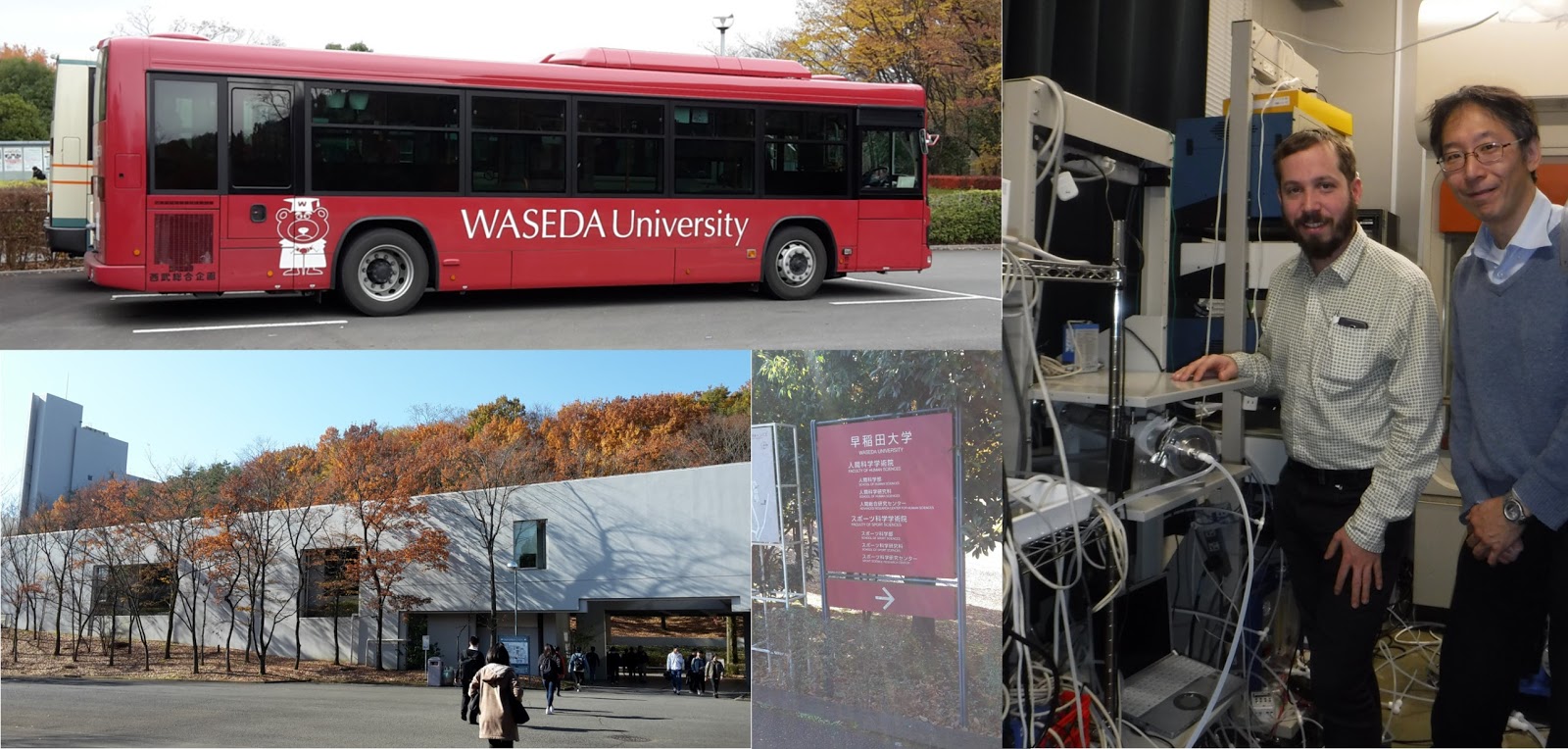
Prof. Jun Matsumoto ( Waseda University , Tokyo, Japan) is one of the few researcher that has published about his experimental research on ozone reactivity. I recently visited his laboratory on the Tokorozawa Campus to discuss his research. As I was reading about ozone reactivity measurements for proposals, a name stood out: Prof. Jun Matsumoto. He published results from ozone reactivity measurements a few years ago (Matsumoto, 2014) and I contacted him to ask if he would be wiling to host me for a visit at the beginning of the project to familiarize myself with his method. He agreed and as the proposal got funded , I started to organize my trip to Tokyo, which took place at the end of November and beginning of December. Prof. Matsumoto met me on the first day at the Tokorozawa train station, next to my hotel, and we traveled together with train and bus to the university campus. There we first discussed about the current state of his research and on the following day, we visited ...

Centre of Excellence annual seminar: 2017 edition

The annual seminar of the Centre of Excellence (CoE) in Atmospheric Science – From Molecular and Biological Processes to the Global Climate led by Academician Markku Kulmala took place in Helsinki last week from 4 to 6 October 2017. The seminar offers a unique opportunity for participants to share their work and discover the work of collaborators beyond their immediate field of research to foster innovative future research. What is a Centre of Excellence? Funding provided by the Academy of Finland to CoEs aims at creating research and training networks to achieve long-term (and even risky!) objectives. The Academy of Finland's Centres of Excellence (CoE) are the flagships of Finnish research. They are close to or at the very cutting edge of science in their fields, carving out new avenues for research, developing creative research environments and training new talented researchers for the Finnish research system and Finnish business and industry. (Source:  A...

Welcoming Anssi Liikanen

Image
Today we are pleased to welcome M.Sc. Anssi Liikanen as a new member of the Air Quality group at the Finnish Meteorological Institute. Anssi starts his PhD studies during which he will develop ozone reactivity measurements and conduct field measurements. As a part of my  REAC-FORTE  project (Academy of Finland, grant 307797 ), ozone reactivity will be used as a tool to assess our understanding of tree emissions and air chemistry in forest air at high latitude (Finland) and high altitude (Switzerland). Biogenic volatile organic compounds emitted by vegetation, such as isoprene and monoterpenes, have a double carbon-carbon bond in their structures, enabling reaction with ozone. By comparing the total ozone reactivity with the reactivity expected from known emissions in combination with other measurement techniques, we will be able to know how much of the chemical composition of forest air is still not well understood. Anssi's background in atmospheric sciences with a focu...

The Comparative Reactivity Method at the Finnish Meteorological Institute

Image
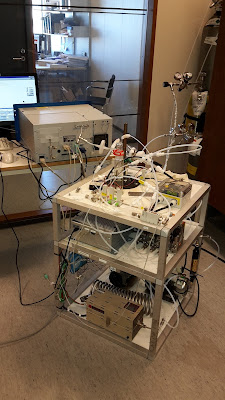
As part of my postdoctoral work at the Finnish Meteorological Institute, I developed a new implementation of the Comparative Reactivity Method to measure total hydroxyl (OH) reactivity from ambient air and emissions. The description of the instrument and results from our first study in Helsinki to test the instrument's performances have been published in Atmospheric Environment (open access). The total OH reactivity (also called total OH loss rate) is a measure of how much reactive compounds are present in the air. A higher amount of compounds reduces the lifetime of OH. It appears that the total OH reactivity in forested environments is higher than expected from known measured compounds, mostly volatile organic compounds (VOCs) emitted from the vegetation. In order to study this missing OH sink also observed in the summer in the boreal forest (Sinha et al., 2010; Nölscher et al., 2012) during various seasons, Dr. Heidi Hellén proposed to develop an instrument based on the ...

Teaching in the Arctic... in socks!

Image
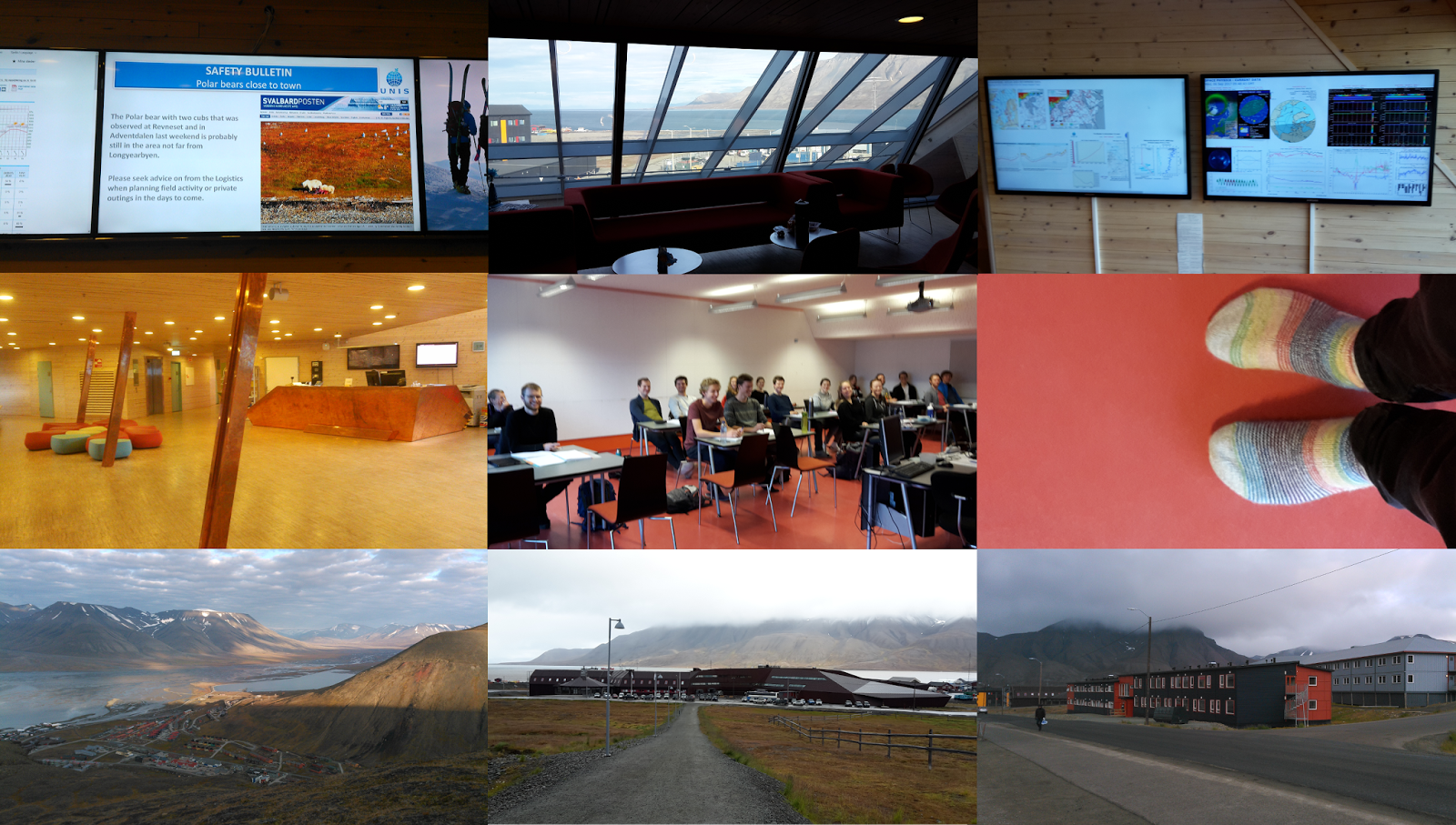
I was invited as a guest lecturer at the University Centre in Svalbard (UNIS) in Longyearbyen between 4 and 8 September 2017. This was a unique opportunity on so many levels! As part of the course AGF-213 Polar Meteorology and Climate ,   undergraduate students also learn about atmospheric chemistry, the part of the course for which I was in charge. It was a great opportunity to review and refresh my knowledge on many topics that are not part of my everyday research and their relevance to the polar regions such as: stratospheric chemistry, in particular the ozone hole in the Southern atmosphere and the possible development of one in the Northern Hemisphere   black carbon and its influence on snow melt in the Arctic ( ask president Niinistö !),  as well as geochemical cycles and their effects on the climate . Longyearbyen (and in particular UNIS) is a very special place: it feels vibrant despite the remote location of the settlement and all the modern comfort is...

Small steps towards (scientific) independence...

Image
Here we are! Today marks the start of my Research Fellowship from the Academy of Finland . It also marks the launch of this blog to present my research and reach out to an audience beyond my research community. Being awarded the Fellowship feels like a small breakthrough in my scientific career. I have been working on various proposals during my time as a postdoc and finally my project was ripe enough to be favorably received by my peers. You will find a description of the project in a separate page: REAC-FORTE . In today's blog post, I simply wanted to reflect on the changes implied by my new title of Academy Research Fellow . What changes? Funding:  I now have my own funding source for my salary and also for research costs (including the salary of one graduate student!) Independence: My level of independence increased as a result of the new funding source and I am now a Principal Investigator (PI). Responsibilities:  As PI, I am in charge of the project and I am ...